
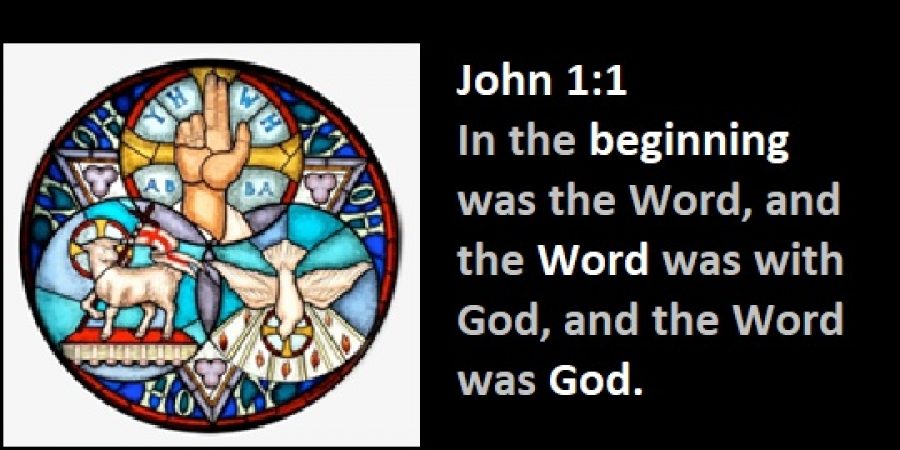
Here is a definition of the Trinity: The Christian doctrine of the Trinity holds that God is one God but three co-eternal and co-substantial persons: the Father, the Son (Jesus Christ), and the Holy Spirit. The three persons are distinct, yet are one “substance, essence or nature”. In this context, a “nature” is what one is, whereas a “person” is who one is.
The doctrine of the Trinity was not fully developed until more than 300 years after the beginning of the Christian church. Not all groups who claim to be Christian accept this doctrine. Other religions, such as Judaism and Islam, also reject this doctrine.
Modern non-trinitarian groups or denominations include Christadelphians, Christian Science, The Church of Jesus Christ of Latter-day Saints, Dawn Bible Students, Iglesia ni Cristo, Jehovah’s Witnesses, Living Church of God, Oneness Pentecostals, the Seventh Day Church of God, Unitarian Christians, United Church of God, and The Shepherd’s Chapel.
When I was in my early 20’s, I met a man who did not believe in the Trinity. I’m not sure what denomination he belonged to but his primary argument against the Trinity was based on John 1:1, “In the beginning was the Word, and the Word was with God, and the Word was God.” (It is apparent from later verses that “the Word” is Jesus Christ.) He believed that this verse was mistranslated in most Bibles. He was taught that in the correct translation that verse should end, “…the Word was a god.” (notice the lower case “g”) As I think about his argument it seems to me, he is not only attacking the doctrine of the Trinity but also trying to deny the divinity of Jesus Christ.
I did a little research on this verse using the Bible Gateway web site. They have 61 versions of the Bible available. All 61 of those versions have the same or similar words at the end of that verse, so “…the Word was God.”
I know that the King James Version was originally translated by a team of over 40 Bible and language scholars, so within all 61 versions I checked it represents the work of well over 100 scholars. The next question I thought of was, “Did only one person get it right while over 100 got it wrong, or is it the other way around?”
It also appeared to me that they were ignoring what was written in John 1:3, “Through him all things were made; without him nothing was made that has been made.” This verse is still talking about “the Word” or Jesus Christ. If Jesus Christ was a participant in the creation of the universe then He must be also a participant in the Divine nature.
Many other verses seem to support the doctrine of the Trinity such as Matthew 28:19, “Therefore go and make disciples of all nations, baptizing them in the name of the Father and of the Son and of the Holy Spirit,”.
Hints that may point to the Trinity appear the book of Genesis. Genesis 1:1 says “In the beginning God created the heavens and the earth.” In the original Hebrew the word for God is “Elohim”. The “im” ending is the way the Hebrew language makes a word plural. I believe that is the first hint of the truth of the doctrine of the Trinity. Genesis 1:26 says, “Then God said, “Let us make mankind in our image, in our likeness, so that they may rule over the fish in the sea and the birds in the sky, over the livestock and all the wild animals, and over all the creatures that move along the ground.”” The use of the plural pronouns, “us” (once) and “our” (twice) seem to me to hint at a conversation between the three persons of the Trinity.
In Genesis 18:1-2 we get another hint, “1The Lord appeared to Abraham near the great trees of Mamre while he was sitting at the entrance to his tent in the heat of the day. 2 Abraham looked up and saw three men standing nearby. When he saw them, he hurried from the entrance of his tent to meet them and bowed low to the ground.” Many Bible scholars interpret these visitors as representing the Father, Son, and Holy Spirit.
Another hint comes in Isaiah 7:14, “Therefore the Lord himself will give you a sign: The virgin will conceive and give birth to a son, and will call him Immanuel.” The word “Immanuel” means “God with us”. In other words when the Son is born, then God will be with us on earth.
Another hint comes from Isaiah 9:6, “For to us a child is born, to us a son is given, and the government will be on his shoulders. And he will be called Wonderful Counselor, Mighty God, Everlasting Father, Prince of Peace.” Obviously the Son to be born is Jesus. In the New Testament the Greek word for the Holy Spirit is “Paraclete”. One of the definitions of that word is “counselor”.
As I said above, the doctrine of the Trinity was developed during the first 300 years of the church. The doctrine was developed slowly and discussed by many of our early church fathers as well as other theories of the relationship between the Father, Son, and Holy Spirit. Those other theories were eventually rejected as heretical. The doctrine of the Trinity was first formalized in the first council of Nicaea in the Nicene Creed. That creed described our beliefs to include, “…And in one Lord Jesus Christ, the Son of God, begotten of the Father [the only-begotten; that is, of the essence of the Father, God of God,] Light of Light, very God of very God, begotten, not made, co-substantial with the Father;…”
I believe in the doctrine of the Trinity. You may choose what you want to believe for yourself but remember, all choices have consequences, many of which we cannot see until it is too late.